
Aluminum wiring and knob-and-tube wiring: how to tell if your home is at risk
By Thomas Quinn · Updated 2026-06-30
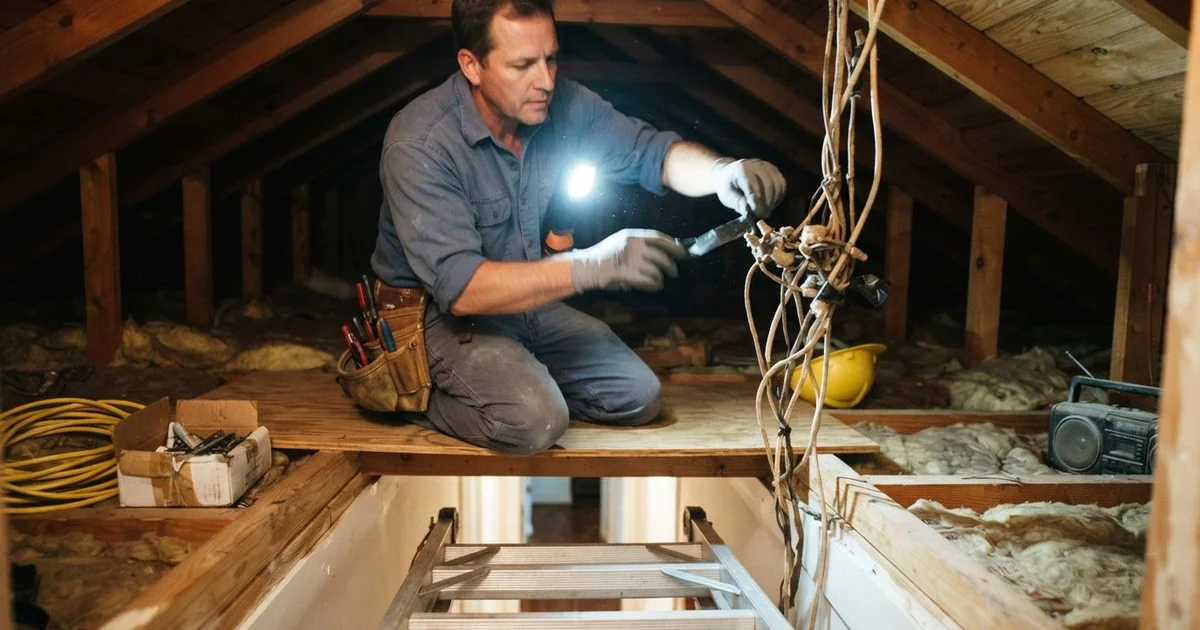
This is general safety information, not an inspection or a substitute for a licensed electrician’s assessment of your home. If you suspect either wiring type, have it evaluated in person before assuming anything based on age alone.
Why these two wiring types get singled out
Most homes built in the last 40 years use copper wiring, but Sanford has plenty of older housing stock, and two earlier wiring methods show up often enough to be worth knowing about. Knob-and-tube wiring was standard in the early-to-mid 20th century. Aluminum branch wiring got used through the 1960s and 1970s when copper prices spiked. Both work fine when installed and maintained correctly, and both develop real problems as they age, which is why residential electricians in this area get asked about them regularly.
Knob-and-tube: what it is and why it matters now
Knob-and-tube wiring runs individual conductors through ceramic knobs and tubes rather than a sheathed cable. It has no ground wire, which alone rules out safely running modern grounded appliances or GFCI-protected circuits on it without additional work. The bigger issue is usually what’s been done to it over the decades: insulation blown in around wiring that was designed to dissipate heat in open air, splices made outside of accessible junction boxes, and unauthorized extensions using non-matching wire. Any of those turns a system that was safe when installed into a real fire risk.
Aluminum wiring: the connection problem
Aluminum branch circuit wiring has a different failure mode. The metal expands and contracts more than copper with temperature changes, which gradually loosens connections at outlets, switches, and breakers. Aluminum also oxidizes, and that oxide layer increases resistance right at the connection point, which generates heat. Neither problem shows up as a visible defect until a connection has already been failing for a while, which is what makes it a slow-building risk rather than an obvious one.
How to check your own home
You don’t need to open walls to get a first read. Look at the wiring visible in your attic, basement, or crawl space, and check any exposed wire behind an outlet or switch cover (with the power off, or better, have an electrician do this part). Aluminum wire is dull silver, not the reddish-orange of copper, and is often printed with “AL” or “Aluminum” along the sheathing. Knob-and-tube is visually distinct: individual black cloth-covered wires running through ceramic knobs and tubes rather than a single jacketed cable.
| Sign | What it suggests |
|---|---|
| Home built 1960s-1970s, never rewired | Possible aluminum branch wiring |
| Home built before 1950, original wiring | Possible knob-and-tube wiring |
| Warm outlet or switch plates | Possible loose aluminum connection, worth immediate attention |
| Ceramic knobs/tubes visible in attic | Knob-and-tube confirmed |
| “AL” or “Aluminum” stamped on wire jacket | Aluminum wiring confirmed |
What electricians typically recommend
A full rewire is one option but not always the only one. For aluminum wiring, pigtailing, connecting a short copper lead to the aluminum wire at each device using connectors rated for the transition, is a common and less invasive repair that addresses the specific failure point without tearing into walls. For knob-and-tube, the fix depends heavily on condition and how much has been altered over the years; sometimes isolated sections need replacement while the rest is left alone, other times a fuller rewire makes more sense once a wall or ceiling is already open for other work.
What not to do yourself
Both problems tempt DIY fixes that make things worse. Wrapping a warm outlet in electrical tape and moving on doesn’t address the loose connection underneath. Splicing copper directly to aluminum without an approved connector, rather than using a proper pigtail method, can create the exact same expansion and oxidation problem in a new spot instead of solving it. If you find either wiring type, the safest move is a licensed evaluation before doing anything beyond turning off power to a clearly warm or discolored device.
The insurance and resale angle
Both wiring types come up during home inspections and insurance underwriting more than most homeowners expect. Some insurers decline to write new policies on homes with active knob-and-tube or unremediated aluminum wiring, or require an inspection and proof of repair first. If you’re planning to sell, buy, or renew a policy on an older Sanford home, it’s worth having the wiring type documented ahead of time rather than finding out mid-transaction.
Compare residential electricians serving Sanford on the homepage, and see our methodology for how we weigh safety-related experience in our scoring.
FAQ
- How do I know if my home has aluminum wiring?
- Check the panel and any accessible outlet or switch. Aluminum wire is dull silver and often stamped 'AL' or 'Aluminum' on the sheathing. If your home was built in the 1960s or 1970s and hasn't been rewired, it's worth having an electrician check.
- Is knob-and-tube wiring illegal?
- It's not automatically illegal to leave in place, but most jurisdictions won't allow it to be extended or connected to modern insulation without modification, and many insurers won't write a policy on a home that still has it active.
- Can aluminum wiring be fixed without a full rewire?
- Often yes. A common fix is pigtailing, where a short length of copper wire is properly connected to the aluminum at each outlet and switch using approved connectors, rather than replacing every run in the house.
- Will my insurance company make me replace old wiring?
- Many insurers ask directly about wiring type during underwriting and either decline coverage, charge more, or require an inspection and remediation before binding a policy on a home with aluminum or knob-and-tube wiring.
Related on this site
- Browse residential electrician providers
- Buying or selling a home in Sanford: electrical issues that come up at inspection
- Level 1 vs. Level 2 home EV chargers: which one do you need
- Electrical safety for aging in place: a checklist for adult children
- AFCI and GFCI protection: what Florida code requires and is a retrofit worth it
- All guides →